


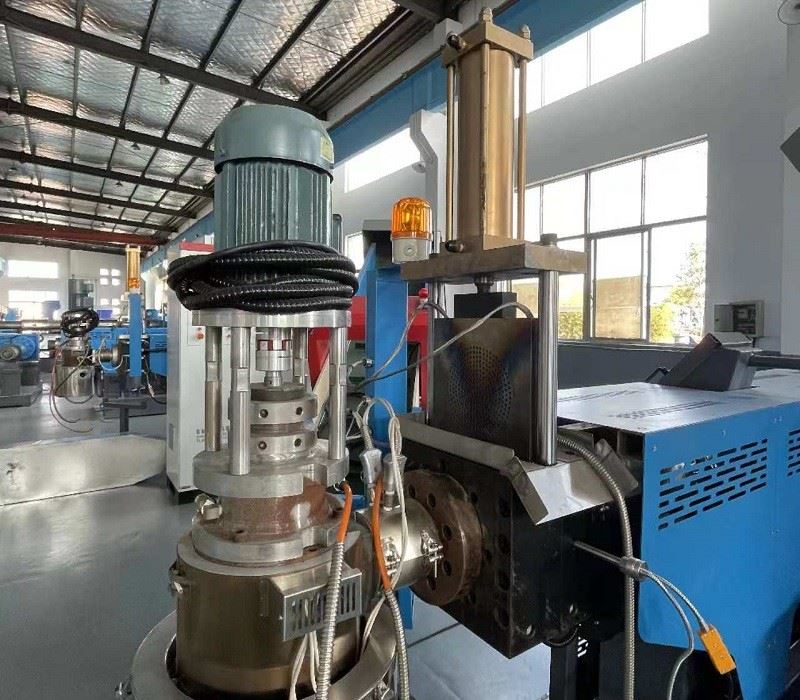

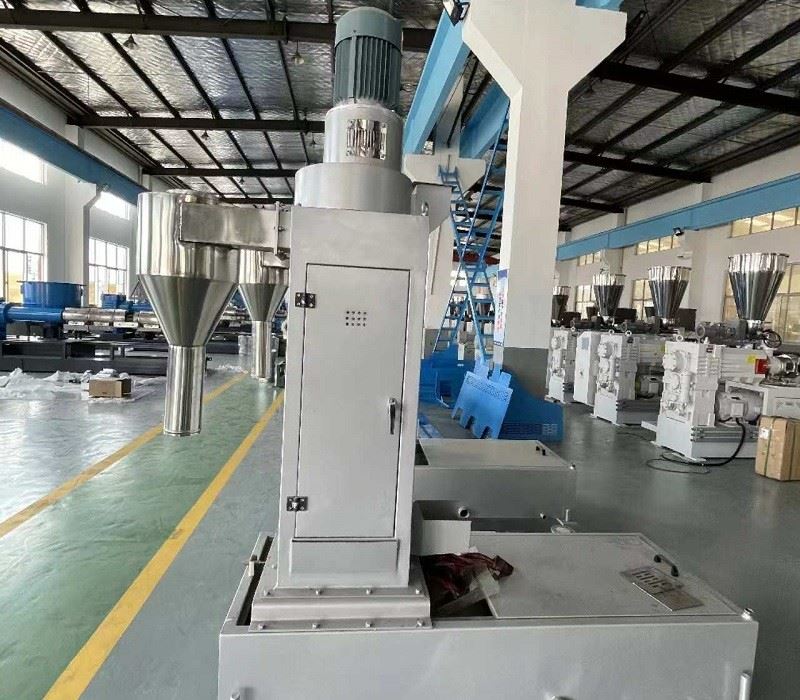

Water Ring Pelletizer
Regular particle shape: It can produce particles with uniform and regular appearance, which helps to improve the quality and appearance consistency of the product. For example, in plastic production, regular particle shape is more convenient for subsequent processing and use.
- Fast Delievery
- Quality Assurance
- 24/7 Customer Service
Product Introduction
Introduction of Water Ring Pelletizer
Advantages:
1. Regular particle shape: Water ring pelletizer excels at producing particles with a uniform and regular appearance. This consistency is critical to improving the quality and uniformity of appearance of the final product. For example, in plastics production, pellets with regular shapes are easier to handle in subsequent processing stages such as molding and extrusion. This reduces defects and results in a more consistent product appearance, which can significantly increase customer satisfaction and reduce waste. Additionally, a regular particle shape improves the flow of the material, making it easier to feed into machines and reducing the risk of clogging or clogging.
2. Efficient cooling: The water ring granulation method is known for its rapid heat dissipation and efficient cooling capabilities. By utilizing a water flow that forms a ring around the template, the particles can be quickly cooled to the right temperature. This process can shorten production cycles by up to 30% compared to other cooling methods. For example, in a typical plastics production line, water ring pelletizing can cool materials from a molten state to a temperature suitable for packaging and storage in a matter of seconds. This not only improves production efficiency but also ensures that the particles maintain their desired physical properties.
3. Reduce dust generation: The water ring pelletizer effectively reduces the amount of dust generated during the cutting process. The water ring forms a barrier that captures and collects fine particles, thereby reducing the amount of dust escaping into the atmosphere. This not only improves the production environment by reducing air pollution but also minimizes material waste. In fact, water ring pelletizers can reduce dust emissions by up to 80% compared to traditional cutting methods. Not only is this good for the environment, but it also reduces the need for additional cleaning and maintenance.
4. Easy to operate: The water ring pelletizer is designed for easy operation and control. Automated systems and intuitive interfaces reduce operator skill requirements and labor intensity. A high degree of automation minimizes manual intervention, thereby increasing production stability and consistency. For example, granulators can be operated via a touchscreen interface, allowing operators to monitor and adjust settings in real-time. This ensures that the production process remains smooth and efficient, even with minimal supervision. Additionally, the granulator's compact design and modular components make it easy to maintain and repair, further reducing downtime and increasing overall productivity.
|
Model |
Screw diameter |
Screw L/D |
Main Motor power |
Product capacity |
|
SJ-85 |
85mm |
28:1~33:1 |
55kw |
150-200kg/hr |
|
SJ-100 |
100mm |
28:1~33:1 |
75kw |
200-300kg/hr |
|
SJ-130 |
130mm |
28:1~33:1 |
90kw |
300-400kg/hr |
|
SJ-150 |
150mm |
28:1~33:1 |
110kw |
400-500kg/hr |
|
SJ-160 |
160mm |
28:1~33:1 |
132kw |
500-600kg/hr |
|
SJ-180 |
180mm |
28:1~33:1 |
160kw |
600-800kg/hr |
|
SJ-200 |
200mm |
28:1~33:1 |
200kw |
800-1000kg/hr |
Applications
1. Plastics industry: Water ring pelletizers play a key role in the pelletizing production of general-purpose plastics and have a huge impact on the manufacturing process of materials such as polyethylene (PE), polypropylene (PP), polystyrene (PS). For example, in the production of plastic films, pipes, and sheets, these raw plastics are first processed by extrusion and then formed into uniform pellets by the water ring pelletizer. This ensures that subsequent processing steps such as molding and extrusion are more efficient and produce higher-quality products. The use of water ring pelletizers can reduce particle size variations by up to 20%, resulting in more stable product quality. In the field of engineering plastics such as polycarbonate (PC) and polyamide (PA), which are used in high-performance applications such as automotive parts and electronic housings, water ring pelletizers guarantee the quality and performance of the pellets. This is crucial because the mechanical properties and thermal stability of these plastics are highly dependent on the uniformity of the pellets. Studies have shown that pellets produced using water ring pelletizers have lower porosity (up to 15% higher) and higher tensile strength (up to 5% higher), which directly contributes to the durability and reliability of the end product.
2. Rubber Industry: In the rubber industry, water ring pelletizers are essential for processing natural and synthetic rubber into uniform pellets. This is particularly important in tire manufacturing, where the rubber raw materials require precise sizes to ensure optimal mixing and molding processes. By breaking down the rubber into particles of specific sizes, water ring pelletizers can better disperse additives and fillers, thereby improving tire wear resistance and reducing rolling resistance. Tires made from rubber pellets processed using water ring pelletizers have longer service life (up to 10%) and are more fuel efficient (up to 3%).
3. Manmade Fiber Industry: In the manmade fiber industry, water ring pelletizers are essential for producing polyester (PET) and polyamide (PA) fibers with consistent particle size. This consistency is critical to achieving uniform fiber diameter and strength, which directly affects the texture, durability, and appearance of the final product. Using a water ring pelletizer can reduce particle size variation by up to 15%, resulting in fibers with fewer defects and higher tensile strength. In addition, the cooling effect of the water ring process helps minimize heat-related degradation, maintain the integrity of the polymer chain, and improve fiber quality.
4. Composites Industry: In the composites industry, which often involves mixing plastics with fibers, metals, or other materials, water ring pelletizers ensure that components are uniform in size and well mixed. This is essential for achieving consistent mechanical properties in the final composite product. For example, when producing reinforced plastics for automotive parts, uniform particle size ensures that the reinforcing fibers are evenly distributed, thereby improving impact resistance and stiffness. Composites processed with water ring pelletizers have a 10% increase in flexural strength and a 5% reduction in weight, making them lighter and stronger.
5. Pharmaceutical Industry: In the pharmaceutical industry, where purity and consistency are critical, water ring pelletizers ensure that polymer-based drugs and excipients are processed into particles of uniform size and shape. This is essential for achieving precise dosing and consistent drug release profiles. Compared to other methods, pellets produced using water ring pelletizers have lower contamination rates (up to 95%), thanks to the closed-loop water system, which minimizes exposure to external contaminants. In addition, gentle handling of the material during the granulation process maintHigh-qualitymical and physical properties, ensuring the efficacy and safety of the final drug product.
Raw material


Final products


Our Advantage


Own production factory & Source quality control Providing customized solutions & Professional technical R&D team.


Efficient, safe, and stable & First-line brand spare parts High quality production standards & International management and certification
Hot Tags: water ring pelletizer, China water ring pelletizer manufacturers, suppliers, factory, pvc pelletizing line, plastic bottle crusher machine, recycled plastic extruder, co rotating twin screw extruder, circuit board shredder, film single shaft shredder


