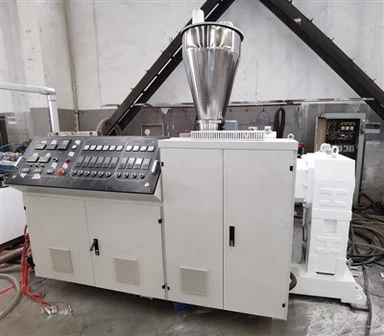


Industrial Extruder Machine
An industrial extruder machine is a critical piece of equipment used in the manufacturing sector to shape materials into continuous profiles. This is achieved through a process called extrusion, which involves forcing material through a shaped opening, or die, under pressure. The machine is widely used in various industries, including plastics, rubber, metals, and food processing.
- Fast Delievery
- Quality Assurance
- 24/7 Customer Service
Product Introduction
Why Choose Us
Our Product
Main products Double-shaft shredder Single-shaft shredder Plastic mill Plastic crusher Plastic twin-screw extruder, series of single-screw extruders, metal and non-metal plastic composite pipes, composite board production lines; complete production lines for plastic profiles, plates, sheets; plastic recycling and cleaning production lines and various auxiliary equipment.
Product Application
Plastics, Rubber, Metal, Wood, Household Waste, Medical Waste.
Production Equipment
Radial Drill,Argon Arc Welding Machine,Sawing Machine,Screw Air Compressor,Machining Center,Gantry Milling Machine.
Technical Services
The company has a high-quality and efficient marketing and technical service team and a large number of experienced professional and technical personnel and senior engineers.
Related Product

The screw assembly is completely self-cleaning, uniform screw clearance, good stirring effect, can process all kinds of polymers.

The two-stage extruder is a popular extrusion molding equipment on the market. Its production process has a high degree of automation, high production efficiency and stability.

The maximum linear extrusion speed is 10m/min, with large capacity and low power consumption, and can achieve 1-5 layers of multi-layer co-extrusion.

The plastic extruder has high-efficiency production capacity. Its scientific structural design and process flow can allow it to run at high speed during the production process, making the entire production process relatively fast and greatly improving production efficiency.

Plastic Waste Extruder Machine
The intelligent processing and production of plastic extruders can match different plastic processing requirements, greatly reducing the processing cycle and achieving more efficient operating benefits.

Recycled Plastic Extrusion Machine
Resource recycling: By using recycled plastics, this machine helps reduce dependence on virgin resources, promotes the recycling of resources, and is in line with the concept of sustainable development.

World famous brands major parts: SIEMENS motor, ABB/FUJI/LG/OMRON inverters, SIEMENS/Schneider contactors, OMRON/RKC temperature controllers, DELTA/SIEMENS PLC syste.

Co Rotating Twin Screw Extruder
SLDS twin-screw compounding extruders possess space saving function, elegant and compact configuration. This type of twin screw extruder adopts world-class inverter and comprehensive alarm system.

The flow channel of barrel is with special design of multi-channel, which can enhance the heat transfer capacity effectively and improve the accuracy of the temperature control.
What is Industrial Extruder Machine?
An industrial extruder machine is a critical piece of equipment used in the manufacturing sector to shape materials into continuous profiles. This is achieved through a process called extrusion, which involves forcing material through a shaped opening, or die, under pressure. The machine is widely used in various industries, including plastics, rubber, metals, and food processing.
How To Set Up The Industrial Extruder Machine?
Temperature Control
Effect of extrusion temperature: Temperature directly affects the melting and fluidity of raw materials, which has an important impact on the performance and appearance of the final product.
Pressure and flow control
The importance of pressure: Pressure directly affects the extrusion speed and shape of raw materials, and has a direct impact on product size and appearance.
Screw speed
Affects the extrusion speed and mixing effect: The rotation speed of the screw directly affects the extrusion speed and mixing effect, and needs to be adjusted according to the characteristics of the raw materials and product requirements.
Cooling system
Control of cooling speed: The cooling speed directly affects the size and appearance of the product. Too fast or too slow cooling may cause problems.
Die design and adjustment
Affects product shape: The design and adjustment of the die head directly determines the shape of the extruded material and needs to be accurately adjusted according to product design requirements.
Machine running speed
Production efficiency: The operating speed is directly related to the production efficiency of the extruder and needs to be reasonably set according to product specifications and quality requirements.
Barrel pressure
Affects the melting of raw materials: The setting of the cylinder pressure is directly related to the melting process of the raw materials in the cylinder, and needs to be adjusted according to the melting point and fluidity of the raw materials.
The Benefits of Buying an Industrial Extruder Machine
Wide range of industrial applications
Many machines are only used in the industrial production of these machines. Therefore, their use range is not easy to cause industrial losses of the factory and affect the subsequent industrial development. Instead, it is necessary to purchase the extruder. It can well promote the use of extruder to many industrial fields, so as to ensure the daily use of extruder and not lead to cost failure. Extruder china is famous all over the world.
Ability to save power for users and prevent over-consumption
The main cost of many factories is not only the raw materials, but also the electricity cost needed to maintain the production and operation of the factory. Therefore, many factories will try to select the ones with low power consumption when selecting machines, the extruder China is just in line with the characteristics of low power consumption and high industrial efficiency, the choice of extruder can better maintain industrial production and provide conditions for the reduction of industrial costs.
Ability to maintain high out put and ensure production
The production of industrial machines is not only related to the consumption of cost but also to the efficiency of production. The extruder can ensure the efficiency of extrusion. It can guarantee the size of plastic extrusion and the speed of each cutting faster when several jobs are carried out. In this way, the plastic products can be dissolved, extruded and cut quickly to ensure the efficiency of the whole industrial process.
The Efficiency Of Each Section Of Industrial Extruder Machine
Generally, granular materials are used for extrusion forming. The feeding device is a device that ensures continuous feeding of material to the extruder barrel, resembling a Buchner funnel, with conical and square conical shapes, also known as a hopper. The connection between the bottom end and the material barrel is the feeding hole, which has a disconnection device that can adjust and disconnect the material flow. There are refrigeration clamps around the feeding holes to prevent the high temperature of the material from conducting heat to the hopper, and to prevent the plastic inside the hopper from heating and sticking, resulting in uneven feeding and obstruction of the material flow. The side of the hopper is provided with a laminated glass sight hole and a calibration, metering and verification device. Some hoppers also have heating and drying vacuum pump pressure relief devices that prevent plastic from digesting and absorbing water from the air, as well as mixing devices that overcome the "railway bridge" caused by powdered plastic, and devices that can perform quantitative analysis and fully automatic feeding at regular times.
The material barrel, also known as the material barrel, is a metal material drum that is subjected to heat and force. The melting and shrinking of raw materials are all carried out in the material barrel. The operating temperature during extrusion forming is generally between 180~290 ℃, and the internal pressure of the material barrel reaches 60MPa. Setting up heating and cooling devices on the outside of the material barrel generally divides heating into three to four stages. Common resistors or inductors for electric heaters also use far thermal radiation. The purpose of refrigeration is to avoid overheating of plastic or to quickly cool the plastic during parking to prevent its dissolution. Refrigeration generally uses air or water cooling for heat dissipation. The material cylinder must bear high pressure, have sufficient compressive strength and bending stiffness, and have a smooth inner cavity. The material barrel is generally used for wear and corrosion resistance, and the friction of plastic causes the plastic to overheat. In addition, the outer surface temperature of the extruder screw is slightly lower than the material barrel to prevent raw materials from adhering to it, which is conducive to the transportation of raw materials.
The Industrial Extruder Machine screw is supported by a thrust bearing suspended in the middle of the material barrel, in line with the axis of the material barrel, without significant error. The gap between the extruder screw and the material barrel is not large, causing the plastic to undergo strong cutting effects and melt and push forward.
Applications Of Industrial Extruder Machine
Industrial Extruder Machine play a crucial role in various industries, enabling the production of an extensive range of products. Their versatility and efficiency make them suitable for numerous applications, from packaging to automotive manufacturing. Understanding the diverse applications of extrusion machines highlights their significance in modern industrial processes.
In the plastics industry, Industrial Extruder Machine are used to create a wide array of products, including pipes, profiles, and films. These plastic products are essential in construction, automotive, and consumer goods sectors. For instance, PVC pipes produced through extrusion are extensively used in plumbing and irrigation systems due to their durability and corrosion resistance.
The packaging industry also relies heavily on Industrial Extruder Machine. They are used to produce films, sheets, and containers that are integral to packaging solutions. For example, blown film extrusion machines create thin plastic films used in packaging applications such as bags, wrappers, and shrink films. These films provide protective barriers for food and other goods, extending shelf life and ensuring product safety.
In the food industry, Industrial Extruder Machine are used to manufacture various food products, including snacks, cereals, and pasta. The process of extrusion cooking involves mixing and cooking the food ingredients within the extruder, followed by shaping them through a die. This method allows for the continuous production of uniform food items with consistent texture and flavor.
The pharmaceutical industry also benefits from extrusion technology. Pharmaceutical extrusion machines are used to produce drug delivery systems such as tablets, pellets, and granules. This process ensures precise control over drug composition and release rates, enhancing the efficacy and safety of pharmaceutical products.
In the metals industry, extrusion machines are used to fabricate components with precise dimensions and complex shapes. Metal extrusion processes can produce items such as aluminum profiles, which are widely used in construction and aerospace applications. These profiles offer high strength-to-weight ratios, making them ideal for structural and lightweight designs.
Additionally, Industrial Extruder Machine are employed in the production of advanced materials such as composites and ceramics. These materials are used in high-performance applications, including electronics, aerospace, and medical devices. Extrusion processes enable the creation of intricate geometries and tailored material properties, meeting the demanding requirements of these specialized fields.
In conclusion, the applications of Industrial Extruder Machine are vast and varied, spanning industries such as plastics, packaging, food, pharmaceuticals, and metals. Their ability to produce high-quality, uniform products with diverse shapes and properties makes them indispensable in modern manufacturing processes.
Future Trends In Industrial Extruder Machine Technology
As technology continues to advance, Industrial Extruder Machine are evolving to meet the changing demands of various industries. Emerging trends in extrusion technology are focused on enhancing efficiency, sustainability, and product quality. Understanding these trends provides valuable insights into the future of extrusion machines and their potential impact on manufacturing processes.
One significant trend is the adoption of Industry 4.0 principles in extrusion technology. Industry 4.0, also known as the Fourth Industrial Revolution, involves the integration of digital technologies and automation into manufacturing processes. In the context of extrusion machines, this trend is manifested through the use of advanced sensors, data analytics, and artificial intelligence (AI) to optimize operations.
Another emerging trend is the development of sustainable extrusion processes. As industries become more environmentally conscious, there is a growing emphasis on reducing waste and energy consumption. Innovations such as energy-efficient heating systems, recyclable materials, and closed-loop recycling processes are being incorporated into extrusion technology. These advancements aim to minimize the environmental impact of extrusion manufacturing, promoting sustainability and resource conservation.
Advancements in material science are also driving the evolution of extrusion technology. New materials with enhanced properties, such as biodegradable plastics and high-performance composites, are being developed for extrusion applications. These materials offer improved performance, reduced environmental impact, and expanded functionality, meeting the evolving needs of various industries.
The customization and flexibility of Industrial Extruder Machine are also expected to improve. Innovations in die design and additive manufacturing techniques allow for the creation of complex and tailored geometries with greater precision. This trend enables manufacturers to produce unique, customized products with shorter lead times and reduced costs.
Additionally, the integration of Industrial Extruder Machine with other manufacturing processes, such as 3D printing, is gaining traction. Hybrid manufacturing techniques that combine extrusion and additive manufacturing offer new possibilities for creating intricate and multi-material products. This approach leverages the strengths of both technologies, enabling the production of complex designs that were previously unattainable.
The future of Industrial Extruder Machine is characterized by the adoption of digitalization, sustainability initiatives, advanced materials, customization, and hybrid manufacturing. These trends are poised to revolutionize extrusion processes, enhancing their efficiency, versatility, and environmental performance, and paving the way for innovative applications in various industries.
Extrusion machines are indispensable tools in modern manufacturing, offering numerous benefits and applications across diverse industries. From the basics of how they operate to the various types available, understanding extrusion technology is essential for optimizing production processes. The advantages of using extrusion machines, including efficiency, versatility, and sustainability, underscore their significance in creating high-quality products.
The applications of Industrial Extruder Machine are widespread, ranging from plastics and packaging to food, pharmaceuticals, and metals. Their ability to produce consistent and complex profiles with diverse materials makes them vital in meeting the demands of these industries. Furthermore, emerging trends in extrusion technology, such as Industry 4.0 integration, sustainability initiatives, and advancements in materials, highlight the ongoing evolution of this field.
Certifications


Our Factory
It can provide customers with more effective, more professional and more complete technical support and after-sales service. With the development of the times, the company always pays attention to new products and new technologies in the field of plastics and grasps and controls them, keeps pace with the times, and always applies advanced concepts and mature and perfect technologies to project development, takes customers as the center, comprehensively considers technological advancement and economic rationality, and strives for the maximum customer satisfaction is always our goal. Quick response, correct direction and efficient on-site processing are the purpose of our service.


FAQ
Hot Tags: industrial extruder machine, China industrial extruder machine manufacturers, suppliers, factory, single shaft shredding machine, large pipe crusher, heavy duty plastic shredder, industrial extruder machine, plastic scrap shredder machine, plastic bag crusher machine
No Information